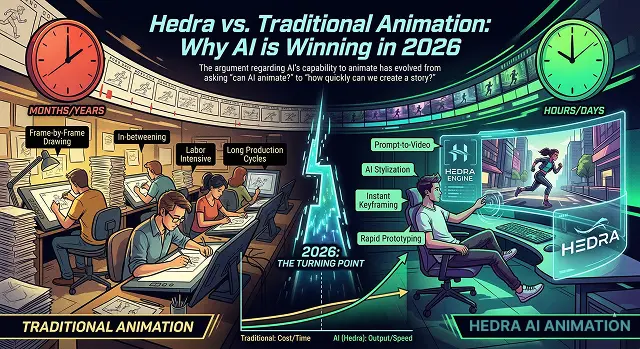
Hedra has positioned itself as a pioneer by concentrating on creating expressive and character-driven animation rather than generating generic animation as many other companies in this arena have.
This paper will discuss the reasons why AI - more specifically, Hedra - is the leader in the race to create quicker animation in 2026.
1. TECHNOLOGY: "Omnimodal" VERSUS FRAME BY FRAME
A traditional animation process must be completed in a sequential way: drawing, rigging, key framing, and rendering. A 60-second clip may take up to several weeks.
- Hedra's Edge: Hedra utilizes a Character 3 Omnimodal model. Unlike older AI technologies, which process audio and sound (i.e., image) separately, the Character 3 model processes sound, text, and visual imagery in an omnimodal fashion and simultaneously.
- Outcome: Producing the industry's highest accuracy for lip sync (9 out of 10) and resulting in the ability to capture the micro-expressions (blinking, head tilt, and eye movements) that animators previously had to program by hand, requiring hours and hours of animators manually programming them.
2. What does it mean to be a “Solo Creator”?
The era of the Solo Creator has arrived as we have seen the speed of animating content increase from a production time measured in days/weeks to a production time measured in minutes/seconds—the same day or shortly after the trend or event occurs. (Production Times: “one day at a time”).
- Example: If an animator wanted to create an animated short showcasing a new product, they could animate that same product by simply uploading the picture of that item to the website and animating the character that would wear or hold that item.
- Additionally, the cost of animation production (one minute of animation) has gone from hundreds of dollars for traditional production facilities (e.g. studios, animation houses) to cents by using AI-generated animation (Cost Difference).
- Example: Traditional animation facility (studio or animation house) charging $2000 for a one-minute commercial compared to a $3 to $8 per month by using an AI animation system through a phone/tablet.
3. The Uncanny Valley Effect No Longer Exists
Many people feel that AI-created “humanoids" look “robotic”, "creepy”, are not “realistic” , have “strange” mannerisms, and thus they do not feel comfortable with the use of AI-created content. In 2026, the Uncanny Valley effect will no longer exist due to:
- Expressions that demonstrate emotion and humanity versus the hyper-realism of the skin.
- By prioritizing the expression and emotional state of the character, opposed to being concerned with how realistic looking the character's skin is, thus creating more “human-like” and, therefore, more relatable.
- Hedra has developed and produced an “AI Animation System" that offers the ability to create “characters” and animations that are automatically “speaking” (with emotion) to a voice that has been recorded for the character. The “Virtual Voice” function of the Hedra Animation System supports 140+ different languages while also providing voice cloning capabilities.
4. Consistency: The "Hedra Elements" Factor
The "blank slate" problem—not knowing how to keep a character looking the same across different videos—was the final hurdle for AI.
- Modular Systems In 2026, Hedra Elements allows users to use pre-built components (outfits, environments, and character bases). This ensures that your brand mascot looks exactly the same in every video, a task that previously required a dedicated team of "character designers" and "clean-up artists."
| ID | Animation Factor | Traditional Workflow vs. Hedra AI Forge |
|---|---|---|
| VS-01 | Creation Speed |
Trad: Weeks of rigging, weight painting, and keyframing. Hedra: Seconds from image/text to full video output. Real-Time Latency |
| VS-02 | Lip-Sync Fidelity |
Trad: Manual phonetic alignment of mouth shapes (Visemes). Hedra: Automatic Audio-to-Mesh synchronization. Viseme Mapping |
| VS-03 | Iteration Flexibility |
Trad: Re-rendering scenes can take hours or days. Hedra: Instant script/voice swapping with Zero-Shot re-generation. Latent Re-Sculpting |
| VS-04 | Barrier to Entry |
Trad: Requires mastery of complex (Maya/Blender). Hedra: Accessible via simple Natural Language prompts. Zero-Code Interface |
| VS-05 | Production Cost |
Trad: Massive studio overhead and specialized hardware. Hedra: Cloud-based rendering accessible on consumer devices. Distributed GPU |
Submit Your Application
Complete the form below to initiate your AI video generation project.
5. The Omnimodal Breakthrough
Character-3: Previously, AI videos were perceived as robotic because the processing of the audio and visual elements occurred separately from each other. In 2026, the Hedra Character-3 model provided the relevant functionality to eliminate this robotic approach by using an omnimodal approach to character generation.
- Simultaneously Processing the Three Modalities: It is not enough to just move a mouth on an image - instead of breaking down the steps for each modality and performing each separately (i.e. processing the text, processing the tone of the audio, and processing the individual pixel values for the image frame), Character-3 processes all three modalities simultaneously.
- Micro-Expression Logic: AI models must understand that what may appear to be a "sad" voice will not only require the lips to be animated from one position to another in order to achieve a realism of lipsync; the AI model must also implement an actual tilt of the head (to look sad), a specific blink rate, and small movements of the eyes. Hedra achieves a 9;10 accuracy in lip-syncing due to their use of "unified" learning within the AI so that final results may be rendered almost indistinguishably from traditional manual keyframing in short-form video content.
6. Democratizing the Pro Workflow
The traditional `pipeline’ for animation consists of the following sequence: Concept → Storyboard → Rigging → Animation → Rendering; this may now be done with a single interface through Hedra's single application.
- Unified Studio: Rather than having to create multiple files in multiple tools (e.g., and image in Midjourney and a voice file through ElevenLabs), with Hedra Studio, users can generate the character (using a character template), clone the user's voice (after recording three lines of audio) and animate the final HD video all in one workflow.
- The Canva Effect: Just as Canva has democratized graphic design for all users, we believe Hedra will have the same effect on democratizing character animation.
7. Scalability in relation to addressing the "Blank Page" issue
One of the very best aspects of Hedra is its Elements feature. In the past, if you needed to make a change to a Character’s outfit or the Character’s Environment, you would have had to re-draw or re-render everything from scratch.
- Hedra’s Elements are like modular building blocks – Predetermined modular blocks that fit into Clothing, Lighting, and Backgrounds. This means that the same Character can be transformed into an entirely new “vibe” in a matter of seconds!
- Multilingual Approach Through Revolutionized Technology
- Hedra supports over 140 languages! For example, a Brand could record an English video in 2026, and through our technology, the Company can then have Hedra automatically redo the animation of the lips and facial features of the Character so that it matches perfectly with a Spanish or Hindi dub of the same video, which would typically take thousands of dollars and many weeks of work.
Hedra vs. Traditional Animation
See how the "Neural Era" stacks up against the classic studio workflow.
In a traditional studio, a single minute of high-quality animation can take months of work from a full team. With Hedra, you can generate that same minute in under an hour.
Traditional animation requires expensive hardware and a payroll for artists. Hedra democratizes this—giving a solo creator the power of a whole VFX house for the price of a monthly subscription.
Yes. In the old way, a "small change" often meant re-drawing hundreds of frames. With AI, you just tweak your prompt or move a slider. The AI re-imagines the scene instantly.
The AI doesn't have "intent"—it only follows your direction. Think of Hedra as a highly advanced paintbrush. The "human touch" comes from your storytelling and artistic vision.
Absolutely! You can upload your hand-drawn sketches into Hedra and use our AI to animate or enhance them. It’s about giving traditional artists super-powers.
Professional tools like Maya usually take years to master. Hedra is built to be intuitive—if you can send a text message, you can animate.
Because we use neural rendering, our servers can generate an entire scene in the time it takes to grab a glass of water. Your computer doesn't even break a sweat.
In traditional animation, matching mouth movements is a tedious task. Hedra’s AI "listens" and animates the mouth automatically with near-perfect accuracy.
Yes. Hedra lets you export high-quality MP4s. You can take your scene and drop it into Premiere Pro or DaVinci Resolve for a final professional polish.
Not at all—it’s an evolution. These tools don't kill creativity; they kill "drudgery," allowing artists to focus on high-level character acting and storytelling.
Ready to try Hedra?
Transform your ideas into cinematic video in seconds.