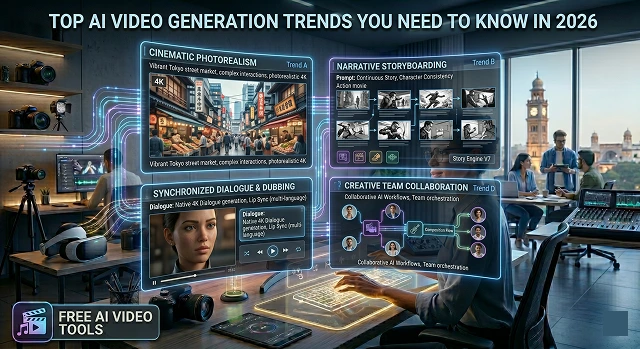
The year 2026 marks a massive shift in AI video. The industry has officially moved past the phase of "cool but glitchy tech demos." Instead, we have entered the era of professional, directable, and highly predictable production workflows.
1. The Death of "Blind Prompting" (The Three-Layer Stack)
Beginning in 2024-2025, those creating something will type two paragraphs of text in order to generate an AI animation that fit those paragraphs. You would cross your fingers that the AI would generate the correct animation, or you would roll the dice again, and thus waste your time and money with each iteration.
In 2026, professional workflows use a Three-Layer Stack that separates visual style from motion:
- Layer 1: The Storyboard. You use fast, cheap AI image models (like Flux 2) to lock in the exact framing, lighting, clothing, and character faces first.
- Layer 2: The Video Engine. Once the static image is approved, a video model (like Wan 2.6 or Veo 3.1) is brought in only to animate it. It treats the image as a non-negotiable reference.
- Layer 3: Orchestration. AI agents chain these clips together, handle transitions, and maintain continuity across scenes.
2. Character Consistency is Now Infrastructure
- A major headache in early AI video was that a character's face, clothes, or hair would shape-shift between shots.
- Character libraries in 2026 will be used to maintain cast databases. Character profile assets can also be built through the advanced system. The character's identity will not vary regardless of placement in office scenes, action sequences, or close-up interviews – they will have the same look, clothing textures, etc.
- Many brands are using them for creating digital spokespeople, and other creators create episodic, narrative content without using physical actors or large CGI budgets.
3. Natural Cinematic Direction Over Text Prompts
AI video platforms have matured to understand the literal vocabulary of filmmaking. You no longer have to describe how a camera moves using creative adjectives.
Instead, modern interfaces give you explicit cinematic controls:
- Camera Grammar: You can set how the camera will move; you can direct the pan tilt zoom, dolly movement or how the camera will shake if it’s handheld.
- Longer Beats: Shot durations have extended beyond the traditional 3-4 second loop and on average will last from between 10-20 seconds, allowing for emotional scenes or suspenseful moments to have time to develop.
- Keyframing: Studios like Higgsfield let you map out motion timelines, giving creators granular control over when and where elements move within the frame.
4. Real-Time and Interactive Video Generation
- Waiting around for render queues is becoming a thing of the past. Thanks to massive efficiency leaps in models like Wan 2.6 and specialized power-user engines (like Fal.ai), real-time scene adjustment is here.
- Creators can utilize the ability to "drive" a live viewport rather than waiting for minute-long rendering times before seeing an output. For example, if you would like to change a background's window view from a sunny day to a rainy night or want an actor to appear more surprised, the AI will dynamically update the pixels without the need to redo the entire sequence from the beginning.
The 2026 Model Leaderboard
| Model / Platform | Best For | What Makes It Special |
|---|---|---|
| Wan 2.6 | Physics & Open-Source | Massive leaps in physics accuracy; objects move realistically without looking "floaty." |
| Google Veo 3.1 | High-End Cinematic | Incredible texture, lighting, and photorealism. Great for big screens and corporate ads. |
| Higgsfield | All-in-One Creators | Aggregates top models into a timeline editor with robust character consistency. |
| Synthesia | Corporate & Training | Hyper-realistic avatars that can naturally gesture, nod, and point at presentation graphs. |
Submit Your Application
Complete the form below to initiate your AI video generation project.
The "Omnimodal" Breakthrough: Simultaneous Video + Audio
Until recently, video and audio were separate pipelines. You would generate a silent video clip, upload it to a sound AI, and try to match up the sound effects.
The modern architecture has transformed the media generation process, including text, image and audio by processing all three together in one unified engine.
- Frame Accurate Audio Matching: In the case of the Veo 3.1 model or the Kling Pro model, when generating the video of a glass bottle being broken on a concrete surface, the model will not just add a generically created "smash" audio but will instead calculate at what moment (frame) during the fall of the glass bottle it strikes the ground and produce the corresponding sound (the sharp make of breaking of glass) that occurs at the exact frame of the glass hitting the ground.
- Environmental Ambiance & Foley: If an image begins in a quiet bedroom and the camera then moves out onto a street in a large city like Mumbai or New York, the AI system will adjust the audio layer to change from being relatively quiet to having very loud stereo sounds of highway traffic, or air flowing past a moving camera, or sounds of people talking at a distance matched to how far away they actually are.
The Multi-Model Studio Aggregators
A major frustration for creators and production teams is that no single AI model excels at everything. Sora 2 might be amazing for narrative storytelling, but it sucks at fast social media formatting; Synthesia is perfect for corporate talking heads, but completely useless for cinematic action scenes.
As a result of this, there has been a dramatic increase in the usage of Multi-Model Aggregators, especially in conjunction with platforms like Hedra. Instead of having 10 different subscriptions to do 10 different things, a creator has a single point of access that serves as their central command hub:
- The Hub Concept: A creator will be able to have a single timeline editor, in which a creator can use an image model (like Flux) to create a character; then switch to Hedra’s flagship Character-3 engine to generate a character with ultra-expressive lip-synch capabilities; then switch to Wan 2.5 or Kling 3.0 to create high-action physics sequences and after creating their final cut, up-scale it to 4K via up-scaling tools embedded within their application.
- API-Driven Scaling: Marketing agencies are hooking these multi-model hubs directly into their CRMs (like HubSpot). If a company wants to send out 5,000 personalized video pitches, the system calls different models automatically—one to alter the presenter's lip-sync to say the client's name, and another to change the background to match the client's industry.
High-Action Physics Simulators (The Uncanny Valley Killers)
Early AI video would completely glitch out if an object interacted with complex physical forces like water, gravity, or fast human kinetics. If a character ran, their limbs would melt; if they jumped into a pool, the water looked like static gelatin.
The 2026 generation of models function less like "pixel guessers" and more like 3D world simulators:
- Complex kinematics: The up-to-date modeling capabilities of virtual reality software have made it possible to accurately recreate very complex human movements, such as Olympic gymnastic routines, triple axels in figure skating, and the precision of a dancer’s pirouette, without any problems occurring. The software accomplishes this by utilizing the information of both the bony structures and mass of the muscles beneath the clothing to ensure that each frame remains anatomically correct.
- Truly accurate interactions with materials: When a basketball player shoots and misses, the ball must bounce back 'correctly' off of the backboard, and the net must react 'realistically' to the air displacement that is caused by the ball's failure to enter the hoop. Any fabric must also move, ripple, or fold naturally based solely on the speed of the wind and the momentum of the character.
2026 AI Video Trends
Stay ahead of the curve with the breakthrough technologies shaping content today.
The major shift is the rise of Native Multimodal Generation. Instead of generating a video silently and adding audio later, cutting-edge models generate high-fidelity video alongside realistic, contextual audio cues simultaneously. Footsteps, ambient wind, or revving engines are natively baked into the generation process.
We have moved completely past random camera drift. Current industry standards rely heavily on Advanced Director Tools like localized Motion Brushes and explicit pathing vectors. Creators can draw arrows to instruct precise camera tracking or isolate micro-movements—like liquid flowing or fabric swaying—while keeping the surrounding frame rock-steady.
This is a massive breakthrough for structural editing. Instead of letting a neural network guess your scene progression, you can anchor a sequence using a specific starting frame and destination frame. The engine handles the interpolation between those two parameters, providing total control over the narrative arc of a clip.
Production has pivoted toward Multi-Image Composition and neural style transfers. Rather than trying to describe complex set designs through text, you can feed the model an image of your character and a secondary image showing your desired layout or backdrop style. The system composits them together cleanly, protecting character continuity perfectly.
Yes, at an exponential pace. Early model variants routinely fell apart after three seconds, but modern frameworks use intelligent clip extensions. Premium diffusion networks review historical frames upstream to append footage smoothly, maintaining environment architecture and character likeness flawlessly across extended runtimes.
With hyper-realism comes structural accountability. Major generative platforms are widely implementing imperceptible, mathematical watermarking like Google's SynthID. This applies a robust, tamper-resistant signature directly within the output pixels and audio noise structures, letting verification systems track synthetic media without impacting visual quality.
Focus entirely on adopting Hybrid Workflows. Generating unique content is no longer about submitting basic strings and rolling the dice. It requires stacking source imagery, locking bounding boxes, mapping specific timelines, and controlling local kinetics. Your technical discernment as a digital director is your eventual differentiator.
Ready to try Hedra?
Transform your ideas into cinematic video in seconds.