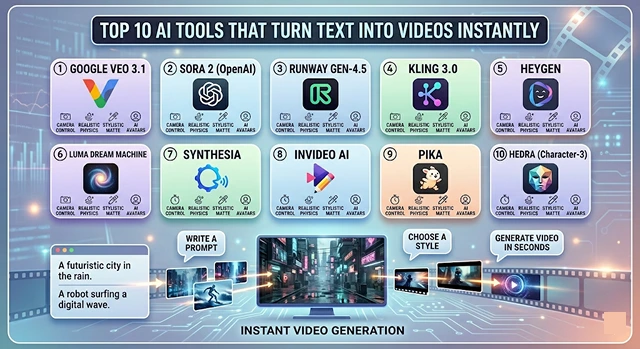
By 2026, things have changed dramatically. The text-to-video tools that used to just be "blurry tests" are now fully developed production studios that create Hollywood quality movies, professional educational training programs, or even viral videos in a matter of minutes!
The "best" tool depends on whether you want a cinematic work of art, a human avatar with accurate facial expressions, or a quick editing solution for social media use. Here are the ten most popular tools currently available.
1. Google Veo 3.1
Best for: Photo-realistic physics and cinematic consistency.
The leading model offered by Google in 2026, and re-developed several times since then, is generally viewed as the "gold standard" for realism. One area where this model stands out is complex physics such as splashing water or blowing hair, which other AIs have difficulty creating accurate representations of.
- Key Feature: Native audio generation (it creates the sound effects and dialogue to match the video perfectly).
- Vibe: Professional, high-fidelity, and extremely reliable.
2. Sora 2
Best for: Visual storytelling and complex narratives.
Sora remains the heavy hitter for long-form consistency. If you need a character to walk through a city and look the same in every shot, Sora 2 is the go-to.
- Key Feature: Deep "world understanding," meaning objects don't randomly disappear when they go off-screen.
- Vibe: Artistic, high-end, and deeply integrated with the ChatGPT ecosystem.
3. Runway Gen-4.5
Best for: Professional directors and "Director Mode."
The Runway application is designed with the "power user" in mind and allows for detailed manipulation (e.g., panning, tilting, zooming) of a camera via either brush or slider controls.
- Key Feature: Multi-Motion Brush - lets you paint precisely where an object in the image should move and where it should remain stationary (e.g., clouds can be animated while mountains remain stationary).
- Vibe: Suitable for those who like to create with their tools, using a technical and creative approach, as well as providing them with a method to "direct" their own work versus simply prompting it.
4. Kling 3.0
Best for: 4K visual quality and high-frame rates.
Coming out of Kuaishou, Kling 3.0 has shocked creators with its ability to export native 4K at 60fps without extra upscaling. It’s particularly popular for creating food and nature close-ups.
- Key Feature: Incredibly realistic "texture" interactions - you can really sense the steam from a hot cup of coffee.
- Vibe: Energetic, clean, and performance based.
5. HeyGen
Best for: Business presentations and "talking heads."
When you need someone talking to the camera in a video for training or marketing purposes, HeyGen provides the best service. The lip-syncing on HeyGen’s videos has reached the point where it will become indistinguishable from an actual video.
- Key Feature: Instant Avatar – this creates a digital version of yourself in less than 5 minutes, using only a cellphone video as the basis for copying your face.
- Vibe: Professional/corporate feel while providing extraordinary speed and efficiency for marketing purposes.
The High-End "Cinematic" Tier
Build Fast with AI · High-Fidelity Storytelling
| Tool | Pricing (2026) | Max Quality | Best Feature |
|---|---|---|---|
| Google Veo 3.1 | $0.10 - $0.60 / sec | 4K @ 60fps | Physics Accuracy: Water and light interact perfectly. |
| Sora 2 (OpenAI) | ~$20 / mo (Standard) | 1080p HD | Consistency: Characters look the same across shots. |
| Runway Gen-4.5 | $15 / mo (Standard) | 4K Upscaled | Multi-Motion: Direct exactly what moves. |
Submit Your Application
Complete the form below to initiate your AI video generation project.
6. Luma Dream Machine
Best for: Bringing things quickly into existence and spontaneous fun designs.
Luma has very fast prototype capabilities and experiments with new fantastic features first likely to explode on social media (e.g. "AI Hug" feature or "AI Zoom" feature).
- Key Feature: Very quickly generates content (in less than one minute).
- Vibe: Fun, Fast, beginner-friendly.
7. Synthesia
Best for: Enterprise-scale training and localized content.
Synthesia focuses on the corporate world. It allows companies to turn a PDF or script into a full training video in 140+ languages using diverse AI avatars.
- Key Feature: AI Dialogue Scenes, where two AI avatars can have a natural conversation with each other.
- Vibe: Structured, professional, and built for massive scale.
8. InVideo AI
Best for: YouTube creators and "Full Episode" generation.
InVideo is unique because it doesn't just generate a 5-second clip; it generates the script, the voiceover, the stock footage, and the background music for a full-length YouTube video.
- Key Feature: Prompt-to-Video Workflow, where a single sentence can generate a 10-minute narrated video.
- Vibe: The "lazy creator's" dream—it handles everything from start to finish.
9. Pika
Best for: Specific animation styles and "physics hacks."
Pika has carved a niche in non-photorealistic styles, like 3D animation and anime. It’s famous for its "Pika Effects" that let you melt, crush, or explode objects in your video.
- Key Feature: Pika can automatically create sound effects (SFX) that correspond with the action on the screen.
- Vibe: TStylized, off-beat and perfect for social media.
Best for: Musical content and expressive digital characters.
Hedra is the specialist for character-driven video. It uses its Character-3 engine to focus on emotional range and perfect lip-syncing for singing or intense dialogue.
- Key Feature: Audio-driven animation; you upload a song or audio file and the character acts out the entire performance with full facial expressions.
- Vibe: Expressive, character driven focus with excellent visually creativity for digital creators.
Top 10 AI Video Tools (2026)
From viral clips to cinematic shots—discover the best tools for instant generation.
In 2026, Luma Dream Machine 2.5 and Kling 3.0 lead in speed. Luma is optimized for rapid prototyping, returning high-fidelity 5-second clips in under 90 seconds. These tools are designed for high-iteration creativity where speed and physical accuracy are paramount.
InVideo AI and Pictory are the benchmarks for assembly. Rather than just generating raw footage, they act as "AI Editors." You provide a script, and they automatically source stock clips, generate high-quality voiceovers, and sync captions—perfect for faceless YouTube channels.
Yes, Wan 2.2 (Open Source) and Magic Hour offer the best free tiers. Wan 2.2 is particularly disruptive as a high-performance open model, while Magic Hour provides a generous 400-credit starting balance that allows you to test the entire production pipeline without an upfront cost.
HeyGen Avatar IV remains unrivaled for realism. It features "Digital Twin" technology that maps your likeness and voice into a photorealistic avatar. For corporate training or high-end marketing presenters, its frame-accurate lip-syncing and natural micro-expressions are the industry standard.
Match the tool to the Physics Engine. For 3D water and fabric, use Kling. For cinematic lighting and emotion, use Google Veo 3.1. For surreal, artistic social clips, use Runway Gen-4. In 2026, the best creators use a "Multi-Model" approach rather than sticking to one tool.
Most premium tools now offer Native 4K HDR. Google Veo 3.1 and Sora 2.0 (integrated with ChatGPT Pro) provide native ultra-high resolution. For others, paid plans unlock an "AI Upscaler" button that sharpens 1080p clips into 4K after the initial generation is complete.
Sign in to Luma Dream Machine or Kling AI with Google and type: "A cinematic tracking shot of a futuristic metropolis at golden hour." In the current 2026 landscape, you’ll have a professional clip in roughly 60 seconds.
Ready to try Hedra?
Transform your ideas into cinematic video in seconds.