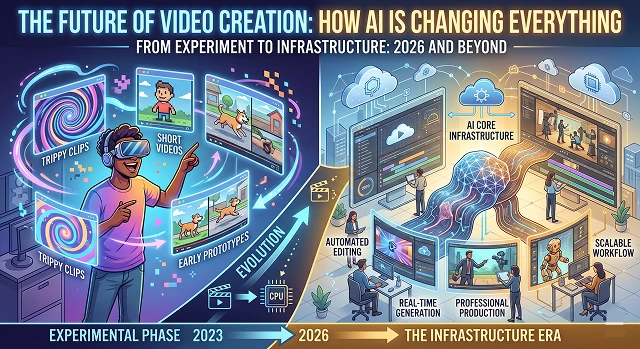
The world of video creation has moved past the "experimental" phase. In 2026, AI is no longer just a tool for making short, trippy clips; it has become the actual infrastructure of the industry.
Here is a breakdown of how AI is fundamentally changing the landscape of video:
1. From "Prompting" to "Directing"
Early AI video felt like a lottery—you typed a prompt and hoped for the best. Today, the focus has shifted to Precise Control.
- Visual Continuity: How can you continue to have the same character, product, location throughout multiple shots? This is the greatest advancement to date. You can now reference one picture to create your character throughout your entire creation - in a scene entering/ exiting a movie theatre, in a car driving on the highway, in a restaurant eating, in a library reading, at a desk with a computer, and outside at the elementary school on the swings.
- Camera Language: Newer technology, such as Google Veo and Runway Gen-4, can also understand the language of cinematography. For instance, instead of being able to identify "a car driving" in an image, you can now easily describe what to use in that scene, such as "dolly zoom," "low-angle tracking shot," or "handheld aesthetic".
- First and Last Images: With the introduction of the ability to upload a first frame and a last frame of that image and for the provider of the service to "hallucinate" a logical progression to that picture; this has reduced the time required to perform certain tasks related to wrapping up a project significantly.
2. The Rise of the "AI Video Architect"
There is an emerging professional role known as the AI Video Architect. This individual is both an editor and camera operator, along with being able to create elaborate workflow designs.
- Hybrid Production: Most high-quality videos produced today contain elements from both the physical world and those created using artificial intelligence.
- The End of the Render Queue: We are in the process of moving into a "real-time" environment where directors will no longer have to wait hours to see how a scene looks after it has been rendered before being able to make adjustments regarding lighting and character expressions.
3. Audio is No Longer an Afterthought
Previously, videos generated using AI didn’t have audio associated with them. Videos generated using AI now feature audio created alongside the corresponding visuals in real-time based on context.
- Scene-Specific Soundscapes: As a result of the scene being specified, if the video is about a rainy street, the sounds of tires on wet pavement and distant thunder will also be created as part of the scene being generated.
- Intelligent Foley Effects: AI-generated video can also produce synchronized foley effects such as footsteps, machine sound, and “emotionally adaptive” music that changes its tone to match the narrative flow of the scene.
4. Democratization vs. The "Human Moat"
AI has lowered the barrier to entry so much that technical skill (like knowing how to use complex software) is becoming less of a "moat."
- Imagination as the Bottleneck: When anyone can generate a $100 million-looking shot for $20, the only thing that separates creators is taste, vision, and storytelling.
- Authenticity 3.0: As the internet becomes flooded with perfect, AI-generated content, "human connection" has become the scarcest resource. Brands are now using AI to scale their digital output so they can spend more time on real-world, "human" experiences.
Key Tools Dominating in 2026
Industry Leaders · Performance Breakdown
| Tool | Best For |
|---|---|
| Google Veo | High-quality, reliable cinematic clips with native audio. |
| Runway Gen-4 | Professional filmmaking and advanced generative "inpainting." |
| Sora | Deep narrative storytelling and complex physical simulations. |
| Luma Dream Machine | Rapid prototyping and "brainstorming" in motion. |
Submit Your Application
Complete the form below to initiate your AI video generation project.
The Death of "Busy Work"
AI is making a difference in the world of post-production. It will take care of a majority of the tedious manual labor involved with post-production.
- Rotoscoping & Clean-Up: An example is rotoscoping (taking out a subject, frame-by-frame), where what used to take an editor days to do is now done in hours with the help of AI.
- Content Aware Editing: An example is using Adobe Sensei to quickly remove unwanted objects from a scene or fill-in a gap with a missing piece, which was something that required specialized VFX artists to do in the past.
- De-aging & Deepfakes: Using digital make-up, AI can change the appearance of an actor, such as with Tom Hanks, into his younger self without any uncanny valley effect like older CGI was using.
AI as a "Craftsman" vs. "Artist"
Industry veterans like Ben Affleck and David Fincher distinguish between craft (the "how") and art (the "when to stop").
- The Problem of Taste: AI can mimic styles, but it lacks "taste"—the human ability to know when a shot is finished or when an imperfection actually makes a scene better.
- The Imitation Loop: Since generative AI pulls from existing data, it risks creating a "low-rent version" of human masters, recycling old art rather than inventing new visual languages.
Pre-Production Revolution
AI is becoming a "brainstorming partner" before a single camera is even turned on.
- Virtual Scouting: Virtual Scouting uses text descriptions to create 3D models of places, allowing filmmakers to "find" locations that arent't real-life.
- Predictive Analytics: Predictive Analytics, used by studios like Warner Bros., uses AI to instantly assess the box-office potential of a movie or how much a star will be paid. This has a direct impact on the decision of whether to fund a project.
- AI Storyboarding: AI Storyboarding allows directors to use tools like Midjourney to instantly create high-fidelity versions of storyboards based on scripts instead of having to draw each frame by hand.
Emerging Capabilities (The "Sora" Effect)
Tools like OpenAI’s Sora are pushing toward "text-to-video" where entire shots are generated from a prompt. However, current limitations include:
- Character Consistency: AI still struggles to keep a character looking identical from one shot to the next.
- Physical Logic: AI often fails to understand the physics of the real world—like how a glass breaks or how a person walks—leading to surreal "hallucinations".
The Future of Video Creation
How AI is shifting the boundaries of imagination and reality.
We are moving toward Generative Cinema. While a single "make a movie" button is still a way off, the future involves "Prompt-to-Scene" workflows where creators dictate the plot, and AI generates the lighting, acting, and camera work instantly.
In the future, videos won't be static. AI will allow for Real-Time Rendering where a video adapts to the viewer. Imagine an educational video that changes examples based on your specific hobbies—AI makes this on-the-fly customization possible.
AI is creating a new category: Digital Twins. Rather than replacing humans, many actors are licensing their AI likenesses. This allows them to "perform" in a hundred commercials at once or speak languages they don't know, fundamentally shifting the labor of performance.
As generation becomes perfect, Digital Provenance will become vital. Future videos will likely have cryptographic watermarks to prove if content was shot by a camera or generated by an AI. Transparency will be the most valuable currency in media.
Much like vinyl records, Physical Production will likely become a premium choice. AI will handle the mass-market content, while "human-shot" films will be valued for their authentic imperfections and the physical craft involved.
AI video is the engine for the future of 3D spaces. Volumetric AI will allow users to walk around inside a video. You won't just watch a movie; you will be a floating camera inside a dynamic, AI-generated world.
Focus on Taste and Curation. In a world where anyone can generate a 4K video, the technical skill of filming is less vital than the creative skill of storytelling. Your unique human perspective is the only thing AI cannot replicate.
Ready to try Hedra?
Transform your ideas into cinematic video in seconds.