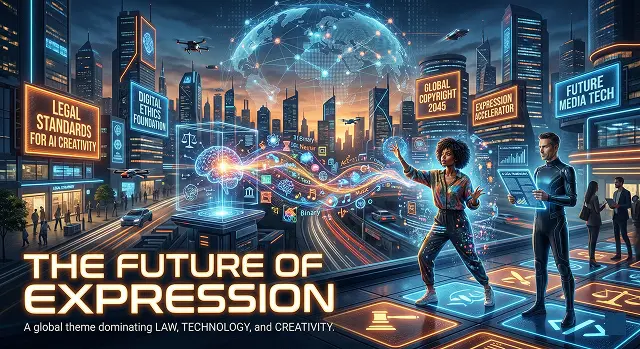
"Expression's future" represents a major theme globally that is present in social policies in both law, technology and art throughout 2026 (multiple books and movies).
Numerous high-level reports - including many produced by the Future Of Free Speech project at multiple world-renowned academic conferences - have objectively assessed the way that artificial intelligence has changed how we communicate, create and share ideas.
A breakdown of the four primary pillars that this theme embodies - using everyday words to explain them to regular people:
1. The Digital Rights Pillar
- The primary official document associated with this title is the 2025 - 2026 flagship document. "AI Laws, Chatbots And The Future Of Expression" discusses the current issue wherein governments around the world have begun passing laws governing AI technology, but often require AI developers to censor particular subjects from being discussed in public.
- Thus, when an AI refuses to answer a question asked of it as a response to an official request by a government (e.g., all responses containing any mention of "abortion"), is that a violation of your right to information? The debate amongst scientists is whether or not "AI Output" qualifies as Free Speech, just like human-originated speech does.
2. Creative Partner Pillar
Historically, in the world of art and design, the Future of Expression indicates that we're moving from the use of AI as a tool for creating (like using a paintbrush) to the use of AI as a partner / co-creator (like a collaborator).
- Multimodal Creativity: We're moving past writing simple text prompts and our definition of what constitutes expression has shifted to include creating "mock-ups" of an idea (like "sketching" it) in order to have an AI render it into a three-dimensional environment or humming a melody in order to have an AI generate "orchestral" accompaniment for that melody.
- Hyper-Personalization: By the end of 2026, "expression" will no longer be one-size-fits-all; that is one expression (e.g., a CEO's update or a creator's video) will be capable of being automatically re-created into ten different languages/cultural styles, while maintaining the original voice of the person who gave it as well as their intent.
- "Human" Backlash: As the internet becomes flooded with AI-generated content, there will be an enormous resurgence to "Classical" Art and drawing by hand. Being a "human" creator has become a mark of luxury when it comes to creative expression.
3. Academic Pillar
In the year 2026, there will be two major conferences taking place, specifically titled:
- Law School (FESC 2026): The Freedom of Expression Scholars Conference serves as a think tank for the legal perspective, focused on how to protect dissent and protesting in a world where people are under constant automated surveillance.
- Tokyo University of the Arts: Their
4. The Great Debate of "Refusal"
The main theme of the current debate is the method by which AI models (such as the one you are using at this very moment) reach a conclusion about what they will or won’t say.
- The Results: Academic studies show that AI models are becoming "shy" and typically refuse to answer controversial social and/or political questions based upon vague triggers (i.e. corporate policy and government pressure) and not upon a lack of data.
- The Consequences: Experts are concerned about a "chilling effect." If we use AI to generate this type of information and then AI is coded to avoid these types of issues, then our ability as a population to develop our own critical thinking and to have discussions about critical issues will be drastically reduced.
5. "Synthetic Media" Will Become The Norm
In 2026 "expression" is not merely typing, it is synthetic.
- Digital Twins: High-level professionals and creatives now utilize "Digital Twins" or AI avatars that have similar look and sound to themselves. For example, a CEO can produce one video in English and the AI Digital Twin will be replicated in 50 languages and perfectly lip-synced with proper culturally associated complexions.
- Hyper-Personalization: Imagine an advertisement in which the above-mentioned brand representative refers to your city, or a character in a movie wearing your favorite shoes. Expression will no longer be broadcasted to everyone, but rather specifically narrowcast to you.
The Future of Expression
Where human creativity meets machine intelligence.
| New Medium | Core Technology | The Creative Shift |
|---|---|---|
| Generative Cinema | Diffusion Models | Text-to-video tools allow solo creators to produce Hollywood-scale epics from a bedroom. |
| Haptic Literature | Wearable Tech | Stories you don't just read, but feel through sensory feedback synchronized with the plot. |
| Neural Art | BCI Interfaces | Direct thought-to-canvas rendering, bypassing the need for physical tools or manual dexterity. |
| Synthetic Music | AI Audio Synthesis | Infinite, non-linear albums that adapt their tempo and mood based on listener heart rate. |
| Spatial Experiences | Mixed Reality (XR) | Digital sculptures and poetry layered onto physical cityscapes via AR lenses. |
Submit Your Application
Complete the form below to initiate your AI video generation project.
6. International "Speech Census"
Rankings by AI system and country of freedom of expression. The United States applies many cases in the courts as a rule of whether AI can speak or not. The EU applies more systematic monitoring and regulation of "Systemic Risk" than the US, which leads to more limit on what can be said by AI.
- The Global South: The research is currently being done in approximately 14 countries in Africa and Southeast Asia to track how AI surveillance is being used to "silence" activists and that "The Future of Expression" will be defined not only in terms of digital policy but also in terms of bodily safety.
7. The "Democratization of Expertise"
This is the most encouraging human based perspective because the gap between having an idea and realising the idea no longer exists.
- No Skill Needed: "The Future of Expression" will allow a person with no musical ability to create a symphony by simply describing the feeling and children to write and "illustrate" a full-length book in an afternoon.
- Value Change: Due to the ease of creating with the availability of new tools, the focus of value in 2026 will not be placed upon the technical expertise of using paintbrushes but rather on the specific unique way in which you express yourself through the art of painting.
The Future of Expression
Exploring the intersection of human intuition and neural creativity.
No. AI acts as a "Neural Cinematographer." It generates visuals, but lacks the subjective taste and narrative intent that only a Director provides. The future belongs to augmented creators.
This allows creators to manipulate video in real-time. Imagine adjusting lighting or expressions while the scene plays, effectively "sculpting" a film as it renders.
AI lowers the barrier to entry for high-end VFX. A single artist can produce sequences that once required multimillion-dollar budgets, shifting value from "funding" to "originality."
Films that adapt based on viewer interaction. Generative Narratives create personalized cinematic experiences where the plot evolves in response to the audience.
Authenticity comes from the imperfection of human choices. By directing the AI to include subtle flaws like grain or camera jitters, the output feels grounded and organic.
This allows creators to apply the visual DNA of any masterpiece onto their footage instantaneously, ensuring consistent artistic texture across infinite frames.
We are moving toward a "Neural IP" model. Creators will train personal models on their unique styles, scaling output while protecting their "Visual Voice."
Yes. Latent World Models can generate 3D environments in response to user movement, leading to stories where the world builds itself as you walk through it.
Multimodal AI generates Foley, scores, and localized dialogue. Creators can now prompt an entire sensory experience, not just silent visuals.
It is the New Renaissance. It removes technical friction, allowing imaginative minds to spend less time and more on the "Art of the Story."