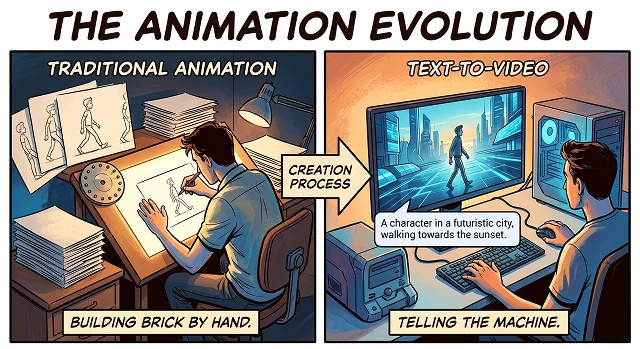
Traditional animation and AI-powered text-to-video are like two different ways of building a house: one involves carving every brick by hand, while the other involves telling a high-tech machine exactly what you want and watching it assemble the structure in seconds.
1. The Creative Process
Traditional animation is a long process that is based on human intention. Every motion, from a character blinking an eye to a blade of grass blowing in the wind, is a conscious decision made by a human being.
- How it Works: Some artists will make storyboards with pictures of the characters they are going to animate and then will animate each frame (i.e. 2D animation) or move the digital models (i.e. 3D animation) to show the character's movement.
- The Human Touch: By having a person draw every single line that is involved in making the animation, there is a level of individuality or style of the artist that is infused into the final piece.
Text-to-Video AI is a short process based on a human being interpreting what they want as the resulting video. You are acting as the director, not the illustrator.
- How it Works: You input a prompt (e.g. "Neon city in cyberpunk with rain and nice lighting") and then the AI will access its massive database of existing images and video clips to predict what pixels will create the video based on their database.
- The Machine Logic: The AI does not "know" what a "city" is. Instead, it knows what the patterns associated with the word "cyberpunk" usually look like in a grouping of lights and colors.
Traditional vs. AI Video
Production Workflow · Time and Effort Comparison
| Feature | Traditional Animation | Text-to-Video AI |
|---|---|---|
| Speed | Weeks, months, or years for a full production. | Seconds or minutes to generate a scene. |
| Iteration | Changing a character's outfit might require redrawing hundreds of frames. | Changing an outfit requires updating the text prompt and re-generating. |
| Labor | Usually requires a specialized team (animators, riggers, lighters). | Can be completed by one person with a computer. |
2. The Anatomy of Movement
In Traditional Animation, movement is built from the ground up using physics and intent. Animators use "squash and stretch" to make a ball feel heavy or a character feel alive. Every arc of a hand-swing is calculated to convey emotion.
In Text-to-Video, movement is "hallucinated" based on probability. The AI looks at millions of videos of people walking and learns that "leg moves forward" usually follows "heel lifts up." It doesn't understand gravity or muscles; it just understands the visual sequence.
3. Consistency vs Chaos
The greatest challenge for artificial intelligence is locating the correct frame to reference.
- The "Anchor" Problem: In traditional animation, animators refer to a model sheet or profile in order to create consistent characters across multiple scenes (e.g., the same character will appear the same way throughout all shots).
- The "Shifting" Problem: When a computer creates an image from individual pixels for each frame, sometimes you see "Temporal Flicker", where a shirt's design may change slightly or hair's length may change second to second.
Detailed Comparison Summary
Deep Dive Analysis · Technical & Creative Breakdown
| Deep Dive | Traditional Animation | Text-to-Video AI |
|---|---|---|
| Logic | Driven by physics & emotion. | Driven by data & patterns. |
| Control | Absolute. Every pixel is intentional. | Variable. You guide it, but it decides. |
| Flaws | Human error (stiff movement, off-model). | Machine error (extra limbs, warping). |
| Best For | Feature films, branding, complex acting. | Prototypes, memes, background visuals. |
Submit Your Application
Complete the form below to initiate your AI video generation project.
4. Creative Control (The "Director" vs. "Artist")
- Traditional (Granular Control): If a director says, "I want the protagonist to look 10% sadder and the wind to blow only her bangs," an artist can execute that exact instruction.
- AI (Prompt Engineering): Relies on a "Seed" for every image created. If you want to change even the most insignificant thing about that photo; it will recreate the content w/ all of the current settings. You have your "creative" or "artistic" side and now you're "curating" your best end products instead of creating it from scratch.
5. The Ethical and Economic Landscape
This is where the human element really clashes:
- Traditional: It’s a massive industry providing jobs for concept artists, voice actors, and technical directors. It is seen as a "pure" art form.
- AI: It’s controversial because it is trained on the work of those very same traditional artists. While it allows a kid in their bedroom to make a "movie," it raises questions about copyright and the future of entry-level jobs in the animation industry.
6. The Core Philosophy: Intention vs. Probability
In Traditional Animation, nothing happens by accident. If a character’s hair blows in the wind, an artist had to decide the direction, the weight of the hair, and how many frames that movement should take. It is a process of pure intention.
In Text-to-Video AI, the system isn't "thinking" about wind or hair. It is looking at the pixels in Frame A and calculating the most likely arrangement of pixels for Frame B based on billions of other videos it has seen. It is a process of statistical probability.
7. The "Director" vs. The "Artist"
The roles change completely depending on the method:
- Traditional Animation: In Traditional Animation, you are an Artist. You need to understand anatomy, perspective, lighting, and timing. You physically build the world.
- Text-to-Video: In Text-to-Video, you are a Director (or Curator). You don't need to know how to draw a horse; you just need to know how to describe a horse and then have the patience to "re-roll" the prompt until the AI gives you a version you like.
Text-to-Video vs. Traditional Animation
The evolution from frame-by-frame labor to prompt-based creativity.
In traditional animation, a 10-second clip could take 20 to 40 hours of drawing and rigging. With AI, that same clip is generated in under 2 minutes. You aren't drawing the movement; you are describing it, allowing for massive production speed.
Your role simply changes from "laborer" to Director. While traditional animators focus on the physics of a single arm movement, you focus on lighting, emotion, and story beats. You control the "vibe"; the AI handles the technical execution.
Absolutely. Studios use it for Rapid Storyboarding and background generation. While hand-crafted animation has its charm, AI is becoming the standard for marketing and indie films where speed and cinematic quality are vital.
This is the Hybrid Workflow. Many creators use traditional software (like Photoshop or After Effects) to create a specific character or background, and then use AI to "animate" those layers. It gives you pixel-perfect control with lightning-speed neural motion.
Traditional animation often requires a team of specialists—riggers, lighters, and animators. AI consolidates those roles into one platform. For a fraction of a single animator's hourly rate, you access an engine that handles lighting, rigging, and rendering instantly.
It's more likely to raise the bar. Just as photography didn't kill painting, AI won't kill animation. It will handle the "standard" work (like explainer clips), while traditional methods evolve into a premium "boutique" craft for projects requiring a hand-touched signature.
Ready to try Hedra?
Transform your ideas into cinematic video in seconds.