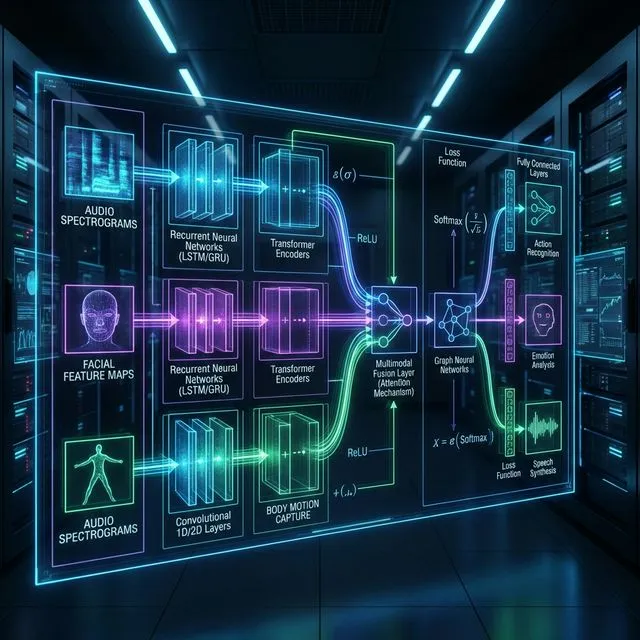
1. The Omnia Foundation Model
Hedra Omnia represents the shift from simple lip-syncing to a unified "Visual Creative Intelligence" platform.
- Omnimodal Processing: Unlike traditional models that process components separately, Omnia processes image, text, and audio in a single stream.
- Natural Motion Synthesis: This unified processing allows the AI to automatically generate synchronized lip movements, micro-expressions, and natural body gestures that match the emotional tone of the audio.
- Temporal Stability: Utilizing a 3D causal VAE (Variational Autoencoder), the model ensures that character features remain stable and do not "flash" or change shape even during complex camera movements like 360-degree spins.
2. Wan 2.2: Physics and Rendering
The Wan 2.2 engine is the powerhouse behind the cinematic fidelity seen in technical benchmarks like "The Void".
- Neural Dark Matter Handling: Wan 2.2 utilizes a specialized VAE that compresses data 2.5x more efficiently than previous iterations. This prevents blocky artifacts and "noise" in pure black spaces, maintaining smooth gradients in extreme low-light scenes.
- Subsurface Scattering: The engine handles high-end rendering techniques natively, such as allowing light to "bleed" through the edges of translucent materials like flowing fabric.
- Atmospheric Simulation: By utilizing Rayleigh scattering and volumetric haze, the model provides a physical medium for light to pass through, creating "god rays" and a sense of physical depth.
- Advanced Collision Logic: The engine simulates realistic physics where light interacts with floating particles, ensuring sharp contact shadows and mathematically consistent 3D environments.
3. Real-Time Performance & Production
- Live Creator Engine: A breakthrough in 2026, this engine has achieved sub-100ms latency. This is the industry standard for real-time interactions, such as AI influencers, customer service avatars, and gaming NPCs..
- Veo 3.1 Fast: Designed for rapid asset generation, this specific engine can generate high-fidelity clips at a rate of approximately 20 credits per second.
- AI Upscaler: To bridge the gap between generation speed and quality, the native upscaler enhances lower-resolution drafts into stabilized 4K assets, removing temporal "shimmering".
4. 3D Spatio-Temporal VAE Architecture
The backbone of the Wan 2.2 engine is its advanced Variational Autoencoder (VAE), which is specifically designed to solve the "Neural Dark Matter" problem.
- Data Compression Efficiency: The 3D causal VAE compresses video data 2.5x more efficiently than previous 2D-based architectures, allowing for higher fidelity without increasing GPU load.
- Neural Dark Matter: Most models fail in pure black spaces, producing blocky artifacts; this architecture maintains smooth gradients in extreme low-light areas by predicting pixel values with higher spatio-temporal precision.
- Temporal Stabilization: By processing the time dimension (temporal) alongside spatial data, the engine eliminates the "shimmering" or "flicking" effects common in earlier generative AI video.
Technical Explanations : The Science Behind Hedra AI
Creating cinematic video from a simple prompt is a complex engineering feat. At Hedra, we have built a stack that goes beyond traditional video generation, focusing on speed, realism, and synchronization. This post breaks down the core technologies that power our studio.
The Omnimodal Engine: Hedra Omnia
Most AI video models process audio and video separately, which often leads to "uncanny valley" results where speech doesn't match facial movement. Hedra uses an omnimodal architecture.
- Unified Processing: Our models—including Character-3—process audio, facial expressions, and body language in a single, simultaneous pass.
- Temporal Consistency: By treating audio as a primary input, the engine ensures that micro-expressions (like a slight squint when shouting) are physically accurate and perfectly timed.
Inference Speed: The Wan 2.2 Model
Efficiency is at the heart of the Wan 2.2 model. For AI video to be a professional tool, it must allow for rapid iteration.
- Optimized Rendering: Wan 2.2 utilizes a more efficient diffusion process that reduces the computational steps required to generate high-fidelity frames.
- Latency Reduction: This architecture enables up to a 50% increase in generation speed compared to older generative models, allowing creators to see results in seconds rather than minutes.
- Motion Physics: Despite the speed, Wan 2.2 maintains superior physics for complex movements like flowing hair or fabric, which are typically the hardest elements for AI to render consistently.
Character Consistency & Style Stacking
One of the biggest technical hurdles in AI video is keeping a character looking the same across different shots.
- Hedra Elements: We utilize a library of pre-configured character "Elements" that act as a fixed visual anchor.
- Style Layers: Creators can stack different visual styles and environments on top of these character anchors, ensuring that the identity of the persona remains stable even if the setting or lighting changes.
Enterprise-Grade Infrastructure
As Hedra scales to power major brands, our technical foundation must be as secure as it is powerful.
- Secure Media Pipelines: Every generation occurs within a secure, encrypted pipeline that protects user-uploaded voice and image assets.
- Commercial Scalability: Our infrastructure is designed for high-throughput, meaning enterprise users can generate thousands of personalized video assets simultaneously without performance degradation.
Technical Explanations
A deep dive into the 3D VAE architecture and the Omnia foundation model.
The 3D Causal VAE ensures spatio-temporal consistency. By compressing data more efficiently, it maintains stable character features and smooth gradients even during high-speed camera orbits or in pure black environments.
Unlike older models that animate parts separately, Omnia processes image, audio, and text simultaneously. This creates a "unified intelligence" where gestures and micro-expressions are naturally synced to the audio's emotional tone.
It refers to the model's ability to maintain smooth gradients in pure black spaces. By compressing data 2.5x more efficiently, the 3D VAE prevents the blocky artifacts common in low-light AI video.
The system utilizes a global phonetic mapping architecture. The Omnia model re-animates mouth shapes natively to match the specific phonemes and accents of over 140 different languages.
Subsurface Scattering simulates how light penetrates translucent materials. In Wan 2.2, this makes character skin and fabrics look physically accurate under cinematic lighting.
The Live Creator engine uses a serverless inference pipeline. By reducing processing layers between audio input and visual generation, the system provides real-time interaction for calls and gaming.
Standard VAEs process frames individually (spatial), but the 3D Causal VAE processes time (temporal) as well. It "remembers" previous frames, ensuring movements are smooth and characters don't change shape.