Here's a rundown of how 4K Upscaling works & what it looks like when we say "Beyond" in the year 2026.
1. What does it mean?
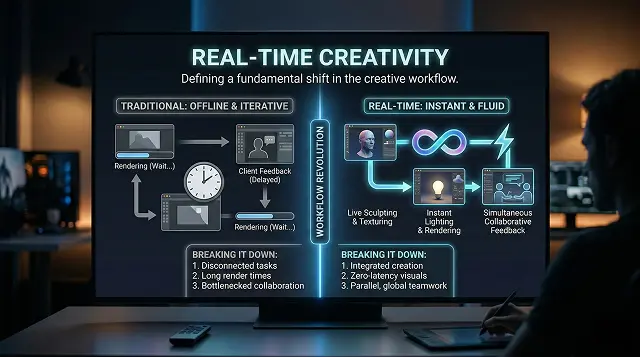
Historically, it would take a long time to create digital art in a traditional workflow. Most people were accustomed to building (or rendering) something and then waiting several hours to several days before seeing the finished product.
"Real-Time Creativity" uses massive computing power to allow a creator to see the completed work (or near completion) as they are creating the piece of art. Think of painting with light — the moment you move your brush the scene is updated.
2. What are the basic components?
- Instant feedback: When you change the colour of an object, the entire environment will reflect that change in the lighting of the scene immediately.
- Interactive in real time: You can use VR or Motion Capture tools to "perform" a digital character in real-time.
- Co-create with AI: You can type in a text prompt and watch the visual change as you continue to describe it with additional words.
3. What are examples of "Creativity in Real-Time" ? Where is It Happening?
a) In Film and Video Games
Virtual production is being used by movies/TV shows like The Mandalorian. Instead of using a green screen, the actors are standing in front of giant LED walls that are displaying a digital world around them. With the click of a button, the Director can move the sun or change the shape of a mountain, and it will happen instantly behind the actor via the LED wall.
b) In Music and Art
Musicians are utilizing applications to create visuals that are based on the sound frequencies created when they play. The...art is not being created in advance; it is "living" because it reacts to how the musician makes the decision to create it at that moment.
c) In Daily Life (AI)
When you use an AI-generated image generator and you can see the generated image while you type the text for an image.or when you use an IA voice assistant to have a human-sounding voice or tone that matches your mood - This is an example of real-time creativity because the machine is using its algorithm to produce a unique output response while you type.
4. Why is this important? (The “Human” Impact)
The greatest impediment to creativity has always been friction. If you have to wait for a computer to catch up, then you lose your “flow” state.
- How quickly you can iterate: Instead of trying to create 1 idea over an hour, you can now create 100 within that timeframe.
- Democratization: The ability to create high-quality visual content no longer requires you to have an expensive ($50,000) server farm; with today’s modern GPUs (graphics processors), anyone can create Hollywood-level graphics from their bedroom.
- Collaborative Magic: Two people from different parts of the world can collaborate together in the same virtual environment and see each other’s changes in real time (within milliseconds).
| ID | Creative Feature | Real-Time Interaction & Use Cases |
|---|---|---|
| RT-01 | Live Expression Scrubber |
Manipulating character emotions on-the-fly via a timeline, allowing for mid-sentence shifts from joy to anger. Dynamic Keyframing |
| RT-02 | Voice-to-Motion Sync | Directly feeding a live microphone stream into the 3D Forge to puppeteer the character mesh with zero latency. |
| RT-03 | Environment Prototyping |
Instant background swapping using integrated "Void" libraries to test character lighting in different 3D worlds. HDRI Link |
| RT-04 | Collaborative Sculpting |
Multi-user sessions where creators refine character traits and scripts simultaneously in a shared cloud studio. Live-Sync Studio |
| RT-05 | Instant Iteration | The ability to re-generate specific facial zones (eyes, mouth) without re-rendering the entire 3D character body. |
Submit Your Application
Complete the form below to initiate your AI video generation project.
5. The Engine of the Flow State
Flow is a state of mind in which one becomes so involved in an activity that they lose track of time. Historically, technology interrupts flow by causing time delays between what we want to do and our ability to do it. For instance, after clicking the "Apply a Filter" button it can take up to 5 seconds for the filter to be applied, or after clicking on the "Export" button, it can take up to 10 minutes to actually export something.
With real-time creative technology, such as augmented reality or generative AI art, the latency between our actions and the output generated by those actions is greatly reduced (less than 100 milliseconds). Therefore, our brains perceive less time as passing between the time of the input (our action) and time we perceive to have elapsed before we receive feedback.
As a result, instead of "operating a machine," we are now "playing an instrument" while creating.
6. The 3 Pillars Supporting Real-Time Technology
In order to create these extraordinarily low latencies, three significant technological advances were necessary:
A. Ray Tracing - The Physics of Light
- For many years, artists had to "fake" their shadows and reflections because the technology did not exist to accurately calculate how light behaves. Now, with real-time rendering engines, we can compute the trajectory of all individual light rays as they reflect off of surfaces.
B. Generative Inference - The AI Brain
- Generative Inference is the process by which artificial intelligence (AI), such as Gemini or MidJourney, creates content. Rather than searching a repository for an image of a cat, a generative AI creates the image of a cat.
7. The Latent Space Concept
In AI-driven creativity, there’s a concept called Latent Space; think of it as an enormous, invisible map that contains all possibilities for ideas, no matter how peculiar they might be.
In the Old Way, you would have to walk around trying to find the right place on this map for your idea.
In Real Time, you now have a teleporter. You swipe your finger on a screen, and your how-to design will morph through thousands of possibilities until you find one that feels perfect.
8. So why is this a revolution?
This is a revolution because it now values your intuition over your technical abilities. For 20 years, you had to be a computer whiz to create complex music or 3D films. Now, due to the speed of feedback, you can learn simply by doing. You no longer have to know how light bounces off a surface; you can simply move the light until you think it looks hott.
Real-Time Creativity
Forget the "wait and see" approach. Create, tweak, and evolve your vision instantly.
Real-Time means you see a "live preview" of your video as you type. It’s like a moving digital sketchpad, allowing you to see if your prompt is working before committing to a full export.
Yes! With the Live-Tweak Slider, you can change a scene from "Noon" to "Sunset" instantly. The AI recalculates shadows and colors on the fly, making it feel more like playing a game than editing.
Only during the editing phase. To maintain speed, previews use lower resolution. Once you finalize the look, the "Premiere" button bakes your choices into a crystal-clear 4K masterpiece.
We use Selective Masking. You can point to a character's jacket and say "Make this leather," and the AI swaps the texture in real-time without re-rendering the entire scene.
Yes. Since the processing happens on our servers, you can experience Real-Time Creativity on your phone just as easily as on a desktop.
You can "Live-Pivot." If a video isn't going where you want, update the prompt immediately. The AI stops the current task and starts redrawing the new version right away.
We call this Sketch-to-Motion. Use a simple brush tool to block out where a character moves or a bolt strikes. The AI builds high-end cinematic visuals around your strokes in real-time.
Yes. Every major change creates a "Snapshot." You can scroll through your session and restore any previous version with one click. It’s an infinite "Undo" for your imagination.
If you can watch a YouTube video without buffering, you can handle real-time creation. You’re essentially watching a smart video stream while our cloud servers do the work.
We're testing Multi-Director Mode. This will allow teammates to jump into the same session, with one person tweaking lighting while the other adjusts camera angles in real-time.
Ready to try Hedra?
Transform your ideas into cinematic video in seconds.