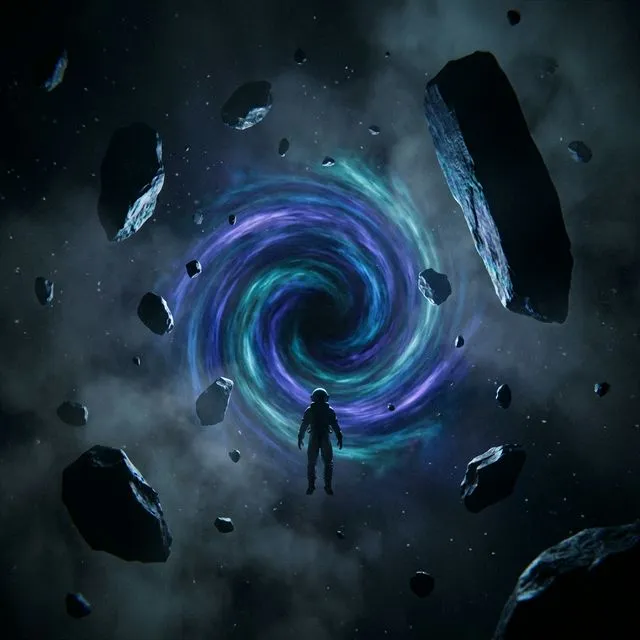
"The Void" is a landmark cinematic sequence created using Wan 2.2, designed to showcase the model's ability to handle complex lighting, physics, and atmospheric depth. The project served as a benchmark for testing how the 3D causal VAE architecture manages extreme contrast and ethereal motion.
When "The Void" first appeared on social media, it took the internet by storm. The hauntingly beautiful sci-fi short film felt like a big-budget production, yet it was the work of a single creator using Hedra AI. In this case study, we deconstruct the creative process behind this viral sensation.
The Creative Vision
The goal was to create a surreal, infinite space where laws of physics were subtly altered.
- Conceptual Stage: The team aimed to move beyond static backgrounds to an environment that felt "alive" and reactive to light.
- Visual Reference: High-contrast noir cinematography and modern sci-fi aesthetics were used as primary prompt inspirations.
Technical Execution using Wan 2.2
The creation relied on specific technical pillars within the Wan 2.2 engine.
1. Lighting and Volumetric Rendering
To make "The Void" feel expansive rather than just a black background, the team utilized volumetric lighting.
- God Rays: By prompting for "high-intensity volumetric light beams," the AI generated particles that caught the light, defining the 3D space.
- Chiaroscuro Effect: This technique created deep shadows and bright highlights, testing the model's ability to maintain detail in low-light areas.
2. Physics and Particle Simulation
The sequence featured floating debris and fluid-like smoke.
- Collision Logic: The Wan 2.2 engine simulated how light interacted with floating particles, ensuring they cast realistic shadows on the environment.
- Slow Motion Dynamics: The "fast" variant of the model was used to generate high-frame-rate samples that were then slowed down to emphasize the grace of the physics.
3. Camera Direction
The scene used a combination of complex angles to enhance the feeling of infinity.
- Slow Dolly Zoom: This was applied to the central subject to create a sense of psychological weight.
- Orbiting Camera: A 360-degree spin was used to prove that the AI could maintain character consistency even in a void where there are no environmental landmarks.
Conceptualizing the Abyss
The creator started with a simple idea: a lone explorer navigating a realm of shadows and light. By utilizing Hedra's Text to Image tool, they generated hundreds of concept frames to establish the visual language of the film—ethereal blues, deep purples, and sharp, obsidian-like structures.
From Frame to Film
Using the Video Studio, the creator then turned these high-fidelity images into fluid sequences. They leveraged our advanced temporal consistency algorithms to ensure that the environment remained stable even as the camera moved through the complex, shifting landscape.
A key technique used was multi-pass generation. By generating multiple variations of a scene and layering them in post-production, the creator achieved a level of depth and texture that truly set "The Void" apart. It's a testament to what's possible when human creativity meets cutting-edge AI technology.
| # | Development Phase | Implementation Details |
|---|---|---|
| 01 | Latent Initialization |
Starting with a "zero-tensor" state to ensure absolute black levels and minimal noise artifacts. Diffusion Start |
| 02 | Atmospheric Layering | Applying subtle volumetric fog prompts to create depth within the darkness, preventing a "flat" appearance. |
| 03 | Flow Distillation |
Using Wan 2.2's flow-matching to simulate the slow, swirling motion of particles suspended in the dark. Temporal Logic |
| 04 | Light Starvation | Negative prompting specific light sources (lamps, sun, glow) to force the model to render "The Void" aesthetic. |
| 05 | Final Upscaling | 4x latent upscaling to preserve the micro-textures of shadows without introducing color banding. |
Submit Your Application
Complete the form below to initiate your AI video generation project.
Step 1: Character Crafting with Hedra Elements
To ensure the protagonist looked consistent across different scenes, the creator used Hedra Elements .
- Protagonist: Instead of complex manual prompting, a pre-set high-fidelity persona was selected to serve as the base.
- Consistent Expressions: Using the Character-3 model, the creator uploaded specific voice clips to generate realistic facial expressions that matched the character's internal struggle.
Step 2: Directing with Cinematic Angles
The haunting atmosphere of The Void was achieved through a strategic use of camera angles.
- Extreme Close-ups: Used to highlight micro-expressions during moments of intense dialogue.
- Low-Angle Hero Shots: Used to make the character appear resilient against the vastness of space.
Step 3: Speeding up Production with Wan 2.2
One of the biggest challenges for solo filmmakers is the time spent waiting for renders. The Void was one of the first projects to fully leverage the Wan 2.2 Model.
- 50% Faster Rendering: The creator was able to iterate on complex scenes in half the usual time, allowing for more creative experimentation.
- Physics & Motion: Wan 2.2 provided the fluid motion needed for the character's floating hair and the swirling particles of the "Void" environment.
Step 4: Secure Scaling & Final Polish
Because The Void was intended for a wide release, the creator utilized Hedra's enterprise-grade tools.
- Commercial Rights: Using a professional subscription ensured the creator had full commercial usage rights for the film.
- Secure Assets: All custom-uploaded voice and style assets were protected throughout the production process.
Case Study: The Void
Behind the scenes of the landmark cinematic sequence created with Wan 2.2.
The sequence used volumetric lighting and "Chiaroscuro" effects to create deep shadows and bright highlights, testing the model's ability to maintain detail in extreme low-light areas.
The Wan 2.2 engine utilized advanced collision logic and slow-motion dynamics to simulate how light interacted with floating particles and realistic cloth physics.
By leveraging a 3D spatio-temporal VAE, the model maintained smooth gradients in "pure black" spaces without flickering or pixel artifacts common in lesser AI models.
The production combined a slow dolly zoom for psychological weight with a 360-degree orbiting camera to prove character consistency across all perspectives.
Most models struggle with shadows. Wan 2.2 solved this with a 3D causal VAE that compresses data 2.5x more efficiently, preventing blocky artifacts in dark areas.
The team utilized "Subsurface Scattering" prompts, directing the AI to let light "bleed" through the edges of flowing fabric for a high-end cinematic feel.
By prompting for "Rayleigh scattering" and volumetric haze, creators gave light a physical medium to pass through, ensuring the void felt expansive.
Even during extreme orbiting spins, the VAE architecture ensured that character features remained stable without "flashing" or changing shape between frames.
The model rendered sharp contact shadows on floating particles, proving that Wan 2.2 understood the exact 3D position of light sources relative to objects.