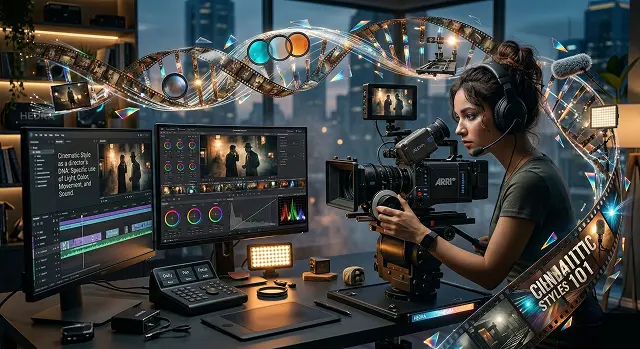
Consider cinematic style as the filmmaker's unique fingerprint. It reflects how the filmmaker utilizes the basic elements of filmmaking (light, color, motion, sound), thereby conveying emotion without using any dialogue (the 'what'). If the script is the 'what then the style can be considered the 'how'.
Here’s a brief overview of the visual languages that have influenced filmmaking throughout history.
1. realism - The window to the world
The objective of realism is to create an invisible camera. Realism looks at different people, natural light, and events that may occur in your life.
- Look: Handheld/shaky camera, natural light/available light, and naturally occurring locations without alteration.
- Feel: Genuine, raw, uncomfortable.
- Classic References: The Florida Project, Nomadland
2. German expressionism - Shadow Play
This style originated in Germany after WWI, does not care about the physical world around us, it hears about the inside of our minds. If a character is going insane, the world around him should appear in disarray.
- Look: High contrast lighting (dark black, bright white), distorted sets (sharp angles), excessive shadows.
- Feel: Anxiety, hatred, madness.
- Modern References: This style can also be recognized throughout all of Tim Burton's movies (Edward).
3. Impressionism and Poetic Realism
- Impressionistic and poetic realism styles depict the movie frame as an artist's canvas rather than a strict narrative. The primary focus of these artistic styles is to create a mood or atmosphere instead of developing a well-structured plot. The viewer feels like they're watching a film about the experience of love in Paris in the early 30s rather than following a plot.
- Examples of poetic realism and impressionism in film can include softly blurred images, rhythm and pace in the editing of one scene to another, and emphasis on small details such as water droplets or a flickering candle.
- The overall experience of these films is one of dreaminess, nostalgia, and romance, such as in the films of Jean Renoir and Amélie.
4. Surrealism: Logic is Our Enemy
- The intent when creating surrealist films is to replicate the mindset of dreaming (or nightmare) through visual images without relying on the logical mind; therefore, surrealist film bypasses the thinking mind and connects with the subconscious mind.
- The visual characteristics of surrealist films can include strange images of impossible objects and non-liner timelines through irrational transitions from one image to another.
- The emotional reactions to surrealist films are confusion, horror or shock and awe. An example of a surrealist film is Mulholland Drive by David Lynch, or David Lynch's earlier films or any of Salvador Dalí's films.
5. Minimalism is defined as "less is more" or perhaps
It can also mean "a way to create a quiet environment in a noisy world through the use of CGI." When minimalism is done well, it allows for the viewer to sit in that space with the characters for an extended period of time without moving the camera; thus, allowing them to observe the subtle changes on the actors' faces.
- The visual style of minimalistic films consists of primarily wide shots, few edits, and a lot of silence.
- The emotional response created by minimalism is one of patience, observation, and an emotional attachment to the characters.
- A great example of a minimalist film would be "Drive" or the films of Yasujirō Ozu.
6. Maximalism - the "baroque style"
The "baroque style" – is an example of the "more is more" concept. The main characteristic of this style is a very high-energy, high-saturation experience that creates a constant barrage of stimulation on the viewer.
- The visual style of maximalist films includes rapid-cut editing, "impossible" camera movements flying through keyholes, and neon-colored backgrounds.
- The emotional response created by maximalism is one of being overwhelmed, electrified, or theatrical.
- A great example of maximalism is "Moulin Rouge!", "Mad Max: Fury Road", or any film by Wes Anderson (though his is more of a "tidy" maximalist version).
| ID | Cinematic Style | Visual Theory & Aesthetic Keywords |
|---|---|---|
| CS-01 | Cyber Noir | Emphasizes high-contrast "Chiaroscuro" lighting with vibrant neon accents against deep shadows. Ideal for gritty, tech-focused character narratives. Rim Lighting Anamorphic Flare |
| CS-02 | Hyper-Realism | Focuses on the meticulous rendering of skin pores, micro-expressions, and natural light physics to bridge the uncanny valley. |
| CS-03 | Ethereal Fantasy | Utilizes soft-focus lenses and "Subsurface Scattering" to create a glow-from-within effect on character skin, perfect for mystical personas. Volumetric Bloom |
| CS-04 | Vintage Analog | Simulates the warmth and grain of 35mm film stock, adding a nostalgic, organic layer that masks AI digital "sharpness." Film Grain Chromatic Aberration |
| CS-05 | Corporate Studio | Minimalist, high-key lighting that ensures maximum facial clarity and shadowless backgrounds for professional or educational avatars. |
Submit Your Application
Complete the form below to initiate your AI video generation project.
7. Mise-en-Scène (The "Stage")
Mise-en-scène (French term for Putting Things On A Stage) French term "mise-en-scène" translates into English literally as putting on stage. Refers to everything visible in front of the camera when capturing any film. If I were to pause a scene in a film and look at each thing within that frame — that is "mise-en-scène."
- Set Design: A set may be messy and disorganized (representing an emotionally chaotic mind) or empty (representing depersonalization).
- Color Palette: Directors will choose what is termed "hero color." For example, the Matrix has a green 'cast' throughout the entire simulation, representing what OLD (n.b., NOT new) computer monitors or screens would look like. When you look at The Grand Budapest Hotel film, the predominant use of colors like pink and purple give you a feeling of storybook quality.
- Costume & Makeup: Costume and make-up give tremendous clues into character development. A character that wears a sharp, severe suit and never has a hair out of place may give the impression that they are someone who is obsessed with control and the need for things to be in order before they're out of control.
8. Cinematography (The Viewpoint of the Camera)
The process by which the camera records the MISE EN SCENE or the visual environment of the film. The means by which a film can be written in "the language of film."
- The Lens: A "Wide angle lens" can create the illusion of space in an area, however distances between faces can become distorted if they are too close. A "Long Lens" creates blurred backgrounds, allowing the subject to seem isolated or "surrounded" by a soft wall of colour.
- Lighting Quality: *High Key: Extremely bright & little shadow (think Sitcoms or Comedies). It feels safe to be depicted.
- Low Key: High Contrast & Deeper Shadows (think Batman or Horror). It seems dangerous or mysterious.
- Camera Movement: A smoothly executed "Dolly Shot" has an elegance and calculation about it. Whereas a "Handheld (or shake)"
Cinematic Styles 101
A guide to directing visual aesthetics and atmospheric moods in your AI renders.
Borrowed from Renaissance painting, Chiaroscuro refers to strong contrasts between light and dark. In prompts, this creates deep shadows and dramatic highlights, perfect for "Noir" or "Thriller" aesthetics.
To replicate this iconic look, prompt for "flat lay composition," "extreme symmetry," and a "pastel color palette." The AI will prioritize centered subjects and a whimsical, highly structured frame.
An Anamorphic prompt adds horizontal blue lens flares and oval bokeh. It creates a widescreen "Hollywood" look that feels more cinematic than a standard digital camera render.
Combine "volumetric smoke," "rain-slicked streets," and "monochrome with amber hints." This directs the engine to focus on texture and light refraction through particles.
Cyberpunk focuses on neon blues and magentas with "high tech" grime. Retro-Futurism leans toward 1950s sci-fi: chrome, analog dials, and grainy film textures.
Giallo is an Italian thriller style known for vivid reds and saturated colors. Use "Technicolor palette" and "extreme close-ups with dramatic shadows" to capture this 1970s vibe.
To break AI smoothness, prompt for "shaky cam," "low-resolution VHS grain," and "unbalanced composition." This creates a raw, amateur aesthetic for horror or documentaries.
High-Key is bright and eliminates shadows (upbeat/commercial). Low-Key emphasizes shadows and high contrast, creating mystery and tension.
Focus on scale. Use "monolithic concrete," "raw geometric forms," and "harsh overcast lighting" to create that cold, imposing, and grand architectural feeling.
Prompting for "Teal and Orange color grading" pushes shadows toward cool blues and skin tones toward warm oranges, making subjects "pop" against the background.