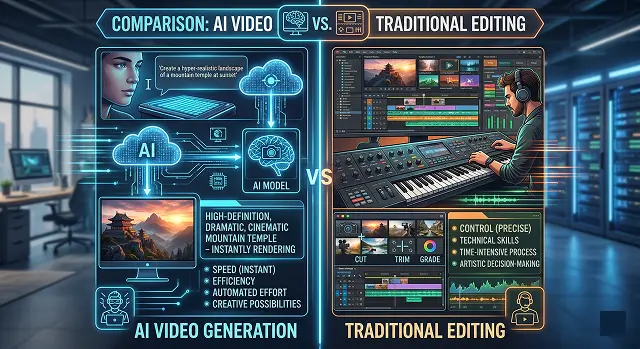
There won't be an argument about either one (AI or traditional) being "better" or "more effective" in 2026. Rather, the competition will boil down to which one best meets the needs of the project. Although AI continues to be a major asset due to its speed and ability to automate tasks, traditional editing continues to be considered the "gold standard" when it comes to providing emotion and accuracy in terms of finishing projects.
Please see below for a comparison of how currently these two forms of video content differ when using the same criteria.
1. AI Video Editing
AI editing tools are no longer limited to basic filters; by 2026, they'll be co-editors that handle most of the time-consuming tasks for you.
Strengths Of The Tools
- "Rough Cut" Within Seconds: AI has the ability to review one hour of video footage, remove any un-necessary spaces of silence, delete "ums" & "ahs" and create a completely clean and cohesive narrative timeline in seconds.
- Text Evaluated Editing: You can actually edit a video by literally editing the text of the transcript of that particular video. If you delete a sentence in the text transcript, then that respective video clip will no longer exist.
- Generative B-Roll: If you don't have a particular shot, then simply tell the AI what clip you need through a text prompt and the AI can generate a commercially licensed video clip to plug that hole.
- Accessibility: Things that used to have hard costs associated with them are now automatic; automated captions, automated dubbing in 50+ languages, and "eye contact" corrections making it look like you are looking into the camera while you're reading your script, will all be standard by 2026.
The Weaknesses
- "The AI Slop" Risk: Over-reliance on AI can lead to generic-looking content. It lacks the "human touch" or comedic timing that makes a video feel authentic.
- Hallucinations: Sometimes AI cuts a scene awkwardly or interprets a word incorrectly, requiring manual fixing anyway.
2. Traditional Editing - The "Craftsman" Style
When we refer to "traditional editing", we are referring to the systems you use to edit your video - like Premiere Pro, DaVinci Resolve and Final Cut. With traditional editing, the editor is intentional with every cut they make in the video to create emotion.
Strengths Of The Tools
- Creating Emotional Nuances: A human professional editor knows that simply holding a shot an extra second can create a feeling of emotional heartache or humor in the viewer. AI algorithms do not yet 'feel' the actual footage.
- Complete Control of Pixels: If a brand has specific color requirements or requires a particular editing speed, and traditional editing system has the ability to give you complete and precise control over pixels. Automated editing systems do not return the same pixel precision.
- Creative Problem Solving: Traditional editors are able to "save" bad productions by the use of clever sound design, pacing and visual storytelling techniques. The skills of an editor require a knowledge of how humans think and feel.
The Weaknesses
- Time Wasteful: Editing hours of recorded material is a long-term, tedious task; thus, editing can be labor intensive and difficult for an editor to complete in an efficient manner.
- High Cost: Because of the price paid for professional editors and software licensing, traditional video editing also tends to be a high-cost process.
AI Video vs Traditional Editing
Workflow Comparison · 2026 Edition
| Feature | AI Video Editing | Traditional Editing |
|---|---|---|
| Primary Goal | Efficiency & Volume | Artistry & Precision |
| Speed | Minutes (Automated) | Hours to Days (Manual) |
| Control | Assisted / Algorithmic | Frame-by-Frame |
| Best For | Social Media, Podcasts, Ads | Films & Branding |
| Learning Curve | Very Low (Prompt-based) | High (Expertise Required) |
| Emotional Depth | Functional & Clear | Deeply Nuanced |
Submit Your Application
Complete the form below to initiate your AI video generation project.
The AI Advantage: “Iterative Intelligence”
Artificial Intelligence as a generative partner in 2026 — it excels at Scale, Speed & Personalization... Show how it can will work together with people at their different levels of production/creativity.
1. Character Consistency and Global Updates
- The “One-Click” Change: Suppose you have a video that is 10 minutes long, and you want the spokesperson to wear a blue shirt, but the customer wants the spokesperson to wear a red shirt instead; editing this in a traditional manner would involve an enormous amount of tracking/masking through every frame. Using AI Workflows in 2026, it would be as easy as typing in, “please change the spokesperson’s shirt to red”, and the AI would automatically take care of everything from lighting to wrinkles in every frame.
- Infinite Localization: Using one Hero Video to instantly produce 50 localized versions with Lip-Syncing AI that ensure the spokesperson’s lips perfectly match 50 different languages while making sure background signage matches local landmarks in any of Tokyo, London or New York!
2. Generative B-Roll & Inpainting
- Filling the Gaps: If you're missing a "shot of a sunset over a rainy city," traditional editors search stock sites for hours. AI editors generate it in 30 seconds, matching the exact color grade and lens focal length of your existing footage..
- Object Removal (Inpainting): Removing a coffee cup from a table or a person from the background used to take "roto-scoping" (tracing frame by frame). AI now does this instantly with "Context Awareness," filling the hole with a perfect digital recreation of the background.
The Traditional Edge: "Intentionality"
Traditional editing is about Emotional Physics. It is still the winner for Cinematic Storytelling and High-End Branding.
1. The "Invisible" Cut
- Human Rhythm: A human editor understands why a cut should happen. They might wait for a character to blink or for a subtle change in the music's bass. AI tends to cut based on math and patterns, which can feel "soul-less" or mechanical in long-form films.
- Creative Misdirection: Great editing is often about what you don't show. A traditional editor can build suspense by intentionally holding a shot longer than "efficient." AI is programmed for efficiency, often missing the power of a lingering, uncomfortable silence.
2. Directing "The Performance"
- Subtlety: AI is great at broad strokes (e.g., "Make this scene look happy"). A traditional editor works with the director to find the one take out of twenty where the actor's eyes showed a hint of doubt. This level of psychological nuance is still purely human.
AI Video vs. Traditional Editing
Understanding the shift from manual frame-by-frame labor to neural-powered creation.
Not at all! Think of AI as your highly skilled assistant. While the AI generates the character and talking motion, you still need an editor's eye for pacing, music choice, and "the cut." AI handles the tedious parts so you can be the Director.
In traditional editing, Lip-Syncing and Keyframing are the biggest time-sinks. AI does this in seconds, allowing you to iterate on 10 versions of a scene in the time it used to take to do one.
It depends on the Direction. By using AI for technical generation but keeping a human in charge of lighting style, emotional tone, and "acting" prompts, you get a result that feels incredibly warm and cinematic.
Significantly. AI video replaces expensive Physical Hardware with software. You can achieve 4K cinematic results on a laptop that would have required a $50,000 studio setup five years ago.
The best creators do both. Learn the rules of film from traditional editing (storytelling, composition) and then use AI to break the limits of what you can actually produce.
In traditional editing, you hunt through timelines. In the AI era, you edit the transcript. If you delete a sentence in the text, the AI automatically cuts that footage. It’s like editing a Word doc, turning hours of scrubbing into minutes of proofreading.
AI Color Matching is a science. Feed the AI a reference image of your brand’s look, and it will apply that exact grade to every clip instantly. It ensures 100% consistency across dozens of videos, a task that would take a human editor a full day.
This is the "final frontier." While traditional film uses the same actor, AI sometimes "drifts." However, with LoRA and Seed Training, we can now lock features. It’s becoming the standard for creators building a recurring digital cast.
Instead of buying stock footage or reshooting, you just type the shot you need. Need a "cyberpunk cafe"? Generate it in 30 seconds. It keeps the creative flow moving without searching through databases for hours.
Think of it like the Synthesizer in music. People once said it wasn't "real" music; now it's a staple. AI is a new instrument requiring its own virtuosity. The art isn't in the button press; it’s in the taste and the vision of the creator.
Ready to try Hedra?
Transform your ideas into cinematic video in seconds.