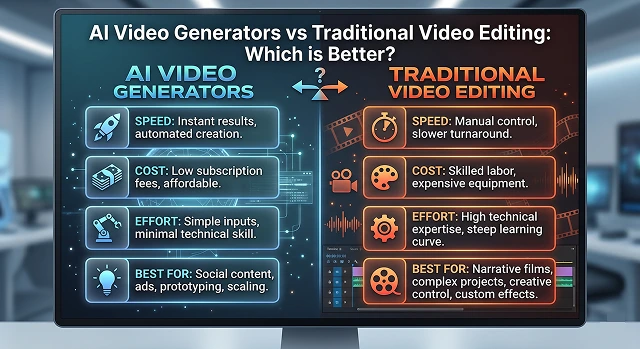
In the year 2026, the discussion between AI and Traditional methods has come a long way from merely a competition, and has reached a mature state of cooperative division of labour. Simply put, AI does work with more speed and volume than Traditional methods but is not as good as Traditional methods for the Creation of Soul and Accuracy.
Here is a comparison of the present capabilities of AI versus Traditional work.
1. Why AI Video Generators Win
Artificial intelligence has greatly changed the way video content is produced leaving no reason for a person to buy a $5,000 camera or go to a studio anymore to produce a professional-looking video.
- Hyper-Speed Production: A person can take a trending event from TikTok at 9am, shoot a high-quality video response and have it published by 9:15 am. Traditional editing processes cannot achieve this fast editing turnaround time.
- Massive Cost Savings: For startups and small businesses, producing their videos using artificial intelligence and software subscriptions for over 90% less on video production costs than using actual locations, lighting crew and talent to produce their videos.
- The "Personalization" Engine: Artificial Intelligence can create five different video variations of one base idea, each variation created specifically for one viewer based on the viewer’s location, language and previous shopping behaviours, where as if done manually would be impossible from a logistical perspective.
2. Conventional Editing is The Best Way to Go
Even with all the new technology, there are many aspects that require human intervention (i.e., real people, real lenses) for the best outcome.
- Emotional Nuance: Human editors understand when they should hold the shot for an additional half-second (or maybe more) to give the shot a moment to "breath." While AI is improving in its ability to apace shot timing, there are still times when it fails to deliver on that "gut feeling" of how to create a true work of art.
- Tactile Reality: In industries such as fashion, high-end jewelry, and luxury automobiles, anything less than seeing the actual light interacting with the physical product will simply not suffice; people tend to shy away from AI-generated images from electric-light sources and consider them too perfect or synthetic when shopping for high dollar products, thereby ultimately eroding brand confidence.
- Copyright Security and Protection: In 2026, legal clarity is expected to become a significant factor regarding copyrights and usage rights of AI-generated content; traditional video footage, created and edited by you, is yours to use however you like. There is still a considerable amount of uncertainty as to whether or not content generated by AI will be protected by copyright or considered "derivative work."
At a Glance: The Core Trade-offs
Strategic Overview · Platform Operations
| Factor | AI Video Generators | Traditional Video Editing |
|---|---|---|
| Turnaround | Minutes to Hours | Days to Weeks |
| Cost | Low ($0.50 – $2.00 per clip) | High ($1,500+ per day for crews) |
| Control | Guided (Prompt & Reference) | Absolute (Frame-by-frame) |
| Best For | Social ads, testing, "faceless" content | Brand films, cinema, high-end product ads |
| Scalability | Infinite (100 videos in a day) | Linear (Limited by human hours) |
3. The Speed vs. Soul Gap
In 2026, one of the biggest shifts will come from how we spend time. With AI viewing video as data and traditional editing viewing video as rhythm; we see two very different approaches to things.
- AI (The Sprinter): Tools like Luma Dream Machine or Sora can take a text prompt and generate a 10-second high-quality video clip in approximately 120 seconds. And, if you require 50 different ads for A/B testing, AI could develop them all within an afternoon where it would take a human team one month to produce them.
- Traditional (The Marathoner): A human video-editor will work at a workstation (i.e. Premiere, DaVinci) and spend several hours micro-pacing—the art of holding a shot for only 2 extra frames to allow the viewer to see the emotion of the character portrayed in the shot. AI has some difficulties in dealing with 'intentional silence' (long pauses – in this case, between lines) and various nuanced emotional arcs that will affect the award.
4. Precision vs. "The Lottery"
While there have been significant improvements in AI video generation, it still has the sense of 'prompt roulette' whereas traditional editing is more like surgical precision.
- Revision Friction: In traditional editing, if a client requests that 'I want this coffee cup two inches to the left,' it takes five minutes to accomplish that. In AI-generated videos, however, that request could require re-generating the entire video segment and change everything from facial expressions to lighting to the backgrounds.
- Consistency: Character consistency will be the 2026 battle ground for the use of AI to produce consistent performances across videos. Traditional filmmakers can ensure that their talent will appear identical throughout all scenes, whereas AI generators use seed references and, while they use them for character consistency and it is getting better, the reality of minor visual glitches or hallucinations still show up in long-form sequences.
5. The 2026 "Hybrid" Workflow
The most powerful creators are no longer choosing sides. They are using a Sandwich Workflow:
- AI Start: Generate a script, storyboard, and background B-roll using AI.
- Traditional Middle: Import those assets into a traditional editor (like Premiere Pro) to cut them to a specific beat.
- Human Finish: Add a real human voiceover or a filmed "talking head" to anchor the video in reality and build trust.
The Financial Reality
Cost Metrics Disruption · Budget Analysis Summary
| Feature | AI Generator (2026) | Traditional Production |
|---|---|---|
| Direct Cost | $30–$100/mo (Subscription) | $1,500–$10,000+ per project |
| Asset ROI | Best for high-volume, "disposable" content | Best for "Hero" content (evergreen) |
| Labor | One "Prompt Engineer" | Editor, Colorist, Sound Designer |
| Legal | Risk of "Copyright Gray Zones" | 100% Owned & Protected Assets |
Submit Your Application
Complete the form below to initiate your AI video generation project.
Creative Control: Precision vs. Probability
- Traditional (The Scalpel): When you edit traditionally, you have mathematical precision. If you want a transition to happen at exactly 12.04 seconds to match a drum beat, you drag the clip there. You own every pixel.
- AI (The Sculptor): AI works on probability. You give it a "vibe" or a "prompt," and it suggests a result. In 2026, the breakthrough is Directable AI. You can now use cinematography terms like "slow dolly zoom" or "crane shot," and the AI understands the physics. However, if you want a very specific hand gesture or a specific brand of soda on a table, AI might still "hallucinate" or change the label slightly unless you use advanced masking.
The "Soul" and Storytelling
- Traditional (Emotional Intent): The art of editing is more than just technical ability to cut and trim footage; it involves having the ability to put yourself in the viewer's shoes. As an example, a human knows that a three-second period of silence immediately following a breakup scene has more impact than if they had waited two seconds before showing the next shot. We as editors have an understanding of many cultural subtleties and nuances, such as irony, sarcasm and so forth, that do not always conform to standard data patterns/logic.
- AI (Data-Driven Pacing): In 2026, AIs are extremely skilled at Engagement Optimization (analyzing the reasons behind the success of specific viral video content). With the help of an AI, you can now quickly analyze multiple viral videos to determine how to cut your own video (e.g. if you cut here, viewers are 20% more likely to continue watching). This is fantastic for performance marketing (i.e., advertisements designed to sell) but exceptionally poor for story-based filmmaking (i.e., movies designed to make you cry).
Production Infrastructure
- Traditional (Logistics Heavy): To get a shot of a snowy mountain in traditional video, you need a plane ticket, a permit, a cold-weather camera crew, and a clear sky. If it rains, you lose thousands of dollars.
- AI (Logistics Light): You type "Cinematic shot of snowy Alps at sunset, 8k, drone footage" and hit enter. In 2026, Character Consistency is the big win: you can now keep the same "AI Actor" across 50 different scenes without their face changing, which was impossible just two years ago.
AI vs. Traditional Editing
Finding the balance between automated speed and manual precision.
The core distinction is Generative Creation vs. Structural Assembly. Traditional editing relies on human precision to arrange pre-shot footage. In contrast, AI generators create the footage itself from text or images. In 2026, the best work uses a hybrid model: AI for raw generation and traditional tools for final rhythmic polish.
For high-volume social content, AI is exponentially cheaper. A subscription costs a fraction of an editor's day rate. However, for bespoke branding, a human's "creative ROI" remains higher—automated tools still struggle with complex emotional nuance that only an experienced human editor can feel.
AI is mathematically superior at syncing beats and removing technical silences. It can analyze waveforms instantly to time transitions perfectly to a kick drum. Modern pros use AI to handle these tedious syncing tasks inside their traditional software, freeing them to focus on the story's "soul."
Yes. In NLEs like Premiere Pro or DaVinci Resolve, you have pixel-perfect authority. Generative AI can be unpredictable; changing a minor background detail often requires a complete re-render. Traditional editing is for absolute precision; AI is for when you want speed and visual exploration.
Traditional editing has a steep learning curve taking months to master. 2026 AI tools can be learned in 15 minutes via natural language prompting. If you need to scale content today without learning "J-cuts" or "three-point edits," AI is the definitive shortcut.
This is the "Director's Workflow" of 2026. Use AI to generate impossible visual assets (like complex VFX or specific B-roll), then export them into a traditional editor to handle color grading, audio ducking, and final pacing. This combines neural speed with manual craftsmanship.
For social platforms, AI usually wins. TikTok and Reels reward consistency and rapid trend adoption over cinematic perfection. AI allows you to maintain a daily high-quality posting schedule without the burnout of traditional 5-hour editing sessions.
Ready to try Hedra?
Transform your ideas into cinematic video in seconds.