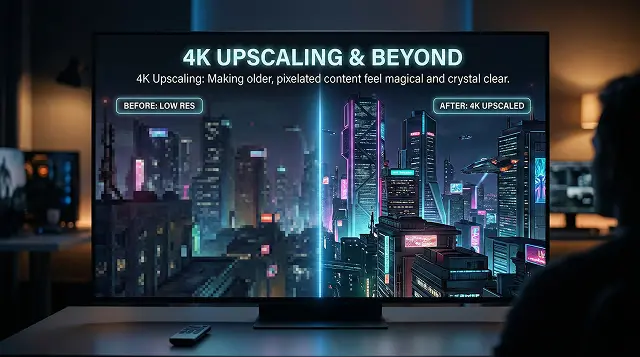
Here's a rundown of how 4K Upscaling works & what it looks like when we say "Beyond" in the year 2026.
1. What is 4K Upscaling ? (The Human Version)
Think of a small, hand-drawn picture (this is your low resolution video example, like 1080P policy), stretched out to fit a huge billboard (this is your 4K/HD TV).
- When you simply stretch the image without adding more detail, the lines become fuzzy and the colours become washed out. This is where upscaling comes in to play – a smart computer fills in the gaps left by the pixel density of an image, by adding new pixels where needed.
- Traditional Upscaling (Copy/Paste Version): The TV simply takes individual pixels from a photo and copies them over to the next pixel. When you magnify an image, it becomes larger, however does not provide greater clarity than its original size.
- AI Upscalling will dominate 2026 within most devices using Neural Networks. With AI powered televisions, they do not simply copy pixels, however rather, they take an understanding of the image that they are seeing. If a TV is viewing a mountain and notices that there is a blurry edge to it, it can create a new rough rocky texture to reflect what it is supposed to look like.
Native 4K vs. Upscaled 4K
Performance Comparison · Technical Brief
| Feature | Native 4K | Upscaled 4K (AI Forge) |
|---|---|---|
| Source | Filmed with native 4K sensors and physical optics. | Filmed in HD/1080p and reconstructed via neural networks. |
| Detail | True, raw pixel data with zero algorithmic interpolation. | Neural hallucination where the AI "draws" missing details. |
| Experience | Perfect structural clarity and organic cinematic texture. | Near-perfect, though can occasionally appear "AI-smooth" in high motion. |
2. What is "Beyond" 4K?
"Beyond" refers to the next frontier where resolution is no longer the bottleneck. It’s about quality, not just more pixels.
A. 8K Upscaling
We are now seeing 8K TVs become practical. Since there is almost no 8K content (movies or shows) available, these TVs rely entirely on "Beyond" upscaling. They take a 4K image and quadruple the pixels again. At this level, the screen looks like a window—you can't see the pixels even if your nose is touching the glass.
B. Generative Reconstruction
This is the latest tech in 2026. Older AI just sharpened edges. New "Beyond" tech uses Generative AI (similar to how DALL-E or Midjourney work) to literally re-create textures.
- Example: If a person is wearing a wool sweater in a blurry old video, the AI creates a realistic wool texture on top of it. It’s not just "fixing" the video; it’s partially re-generating it.
C. Temporal Super Resolution (Gaming)
If you play games, you’ve heard of DLSS or FSR. These "Beyond" technologies allow a game to run at a lower resolution (to keep it fast/smooth) while the AI "paints" a 4K image over it in real-time. It’s the reason modern games can look so realistic without needing a $5,000 computer.
3. Why Should You Be Interested?
Old Films SEEM Like They Were Made Last Week: You could watch a flick from the 90s, and it would appear like it was shot in 2020.
- Superior Streaming: Streaming 4k takes A Lot Of Data! With "Beyond" Technology, You Can Still Stream At A Lower Quality, Saving Davata AND Money. At The Same Time Your Device Will Upscale The Picture To The Good-Looking 4k Resolution!
- Photo Restoration: ou Can Take A Pixelated Picture Of Your Relative Taken 40 Years Ago And Upscale To A Crystal-Clear 4k Print!
| ID | Resolution Tier | Optimization Workflow |
|---|---|---|
| UP- 01 |
Latent Upscaling | Initial resolution boost within Hedra’s 3D Forge to sharpen facial geometry and iris detail before final render. Internal Engine |
| UP- 02 |
AI Face Refinement | Using external temporal face restoration to fix any mouth artifacts or flickering that occurs at high motion intensities. CodeFormer GFPGAN |
| UP- 03 |
4K Volumetric Export | Enhancing the final video stream to Ultra-HD while maintaining the alpha channel for seamless 3D environment integration. Topaz Video AI |
| UP- 04 |
Frame Interpolation | Converting standard 24fps AI output into a smooth 60fps cinematic experience using optical flow estimation. Chronos Model |
| UP- 05 |
The "Void" Final Cut | Applying a professional film-grade color pass and sharpening to ensure the upscaled character looks indistinguishable from real footage. |
Submit Your Application
Complete the form below to initiate your AI video generation project.
4. The Core : AI Super Resolution
Old-school upscaling would take one photograph and just enlarge it, making its blurry parts bigger! But, currently, “beyond” upscaling now includes Deep Learning Super Resolution, referred to as "DLSR".
How does it achieve this?
- Analysis: By scanning the entire picture to determine the shapes (such as skin texture) within it.
- Comparison: After being analyzed, a low-resolution version of the picture (the original picture) is compared to a large number of high-resolution versions of the same picture, as contained in a database (in which the computer system was "trained").
- Synthesis: By using high-resolution 'knowns' to fill in the gap left by the low-resolution 'knowns'. For example, if the AI sees a photograph of a person's eye and the eye appears blurry (there is no defined image of the iris or eyelashes in either the original photograph or the synthetic representation of the iris/eyelashes), the AI will fill in the iris and eyelashes with an image generated during the 'synthesis' stage.
5. What is new in 2026 ("Beyond")?
When originally launched, the technology was focused on producing a higher quantity of pixels. Now (2026), we are moving into a period called Neural Rendering/Temporal Intelligence.
A. Temporal Super Resolution
This is how video and gaming work. Instead of analyzing a single frame, the AI works through the entire sequence of frames preceding and following the one being generated.
- Benefit: Because temporal super-resolution generates frames based on the future and past, the AI can remove motion-blur from every single generated frame (which was previously an issue caused by every low-resolution frame appearing "wavy"—as a result of the use of motion-blur).
B. Generative Frame Reconstruction
New systems provided by NVIDIA DLSS 4.5 and beyond will be able to generate frames using the most advanced artificial intelligence tools (neural network) available today.
4K Upscaling & Beyond
How we take raw AI sketches and turn them into crystal-clear cinema.
Think of it as a digital restoration. Most AI videos start a bit blurry. Our upscaler uses a second AI to "re-draw" frames with sharp textures and crisp edges so they look perfect on a big screen.
Standard is fast and clean, great for social media. Ultra is the heavy hitter—it adds "micro-details" like skin pores and fabric weaves for a professional theater look.
Not at all. The motion stays exactly the same. The AI only focuses on clarity. It’s like putting on high-definition glasses; you just see the existing world much more clearly.
Technically yes, but we don't recommend it. Over-upscaling can make results look "too plastic" or artificial. It's best to do one high-quality 4K pass.
Since 4K has four times the pixels, it requires more power. A 10-second clip usually finishes in 3 to 5 minutes. It’s a small wait for cinematic excellence.
Yes! Our upscaler uses smoothing logic to analyze surrounding frames. It stabilizes textures and light, providing a much steadier, professional-grade result.
Yes! Our Universal Upscaler accepts old AI clips, phone footage, or animations. The AI analyzes the style and applies the best sharpening to match the source.
They get significantly larger. Packing in extra detail means a 4K file can be 5 to 10 times larger than the original. Ensure you have sufficient storage space before downloading.
If a face looks slightly off, try lowering the "Creativity" slider. This tells the AI to stick strictly to the original shapes rather than imagining new skin or eye details.
It's our roadmap for the future: 8K resolution, HDR colors, and 120fps motion. We're not just making the image larger; we're making the entire experience feel more alive.
Ready to try Hedra?
Transform your ideas into cinematic video in seconds.